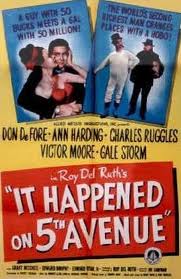
A hobo with an unexplained past figures out how to live in boarded up mansions of absentee wealthy people, gone for the season. He meets up with other unfortunates, who hook up with others, and the story takes off from there.
Victor Moore is the hobo star who is best known to me for his hilarious role in Swing Time (1936) as Pop Cardetti. Charles Ruggles is also a favorite and here he plays the second richest man in the world. These two had long-lasting careers beginning in silent movies and ending with a few appearances on television, and it’s great to see them together.
Filling out the cast are some soon-to-be TV stars, Don Defore (Ozzie and Harriet, Hazel) and Gale Storm (My Little Margie, the Gale Storm Show). And Alan Hale Jr, with over 200 TV and movie roles, became best known for playing Skipper on Gilligan’s Island.
Another notable performances is by actress Ann Harding. Most of her film roles were back in the 1930s, and she adds a beautiful and poignant presence as the ex-wife of Charles Ruggles. She also introduces us to “slumgullion.”
Look for character actors Edward Brophy as the local patrolman and Charles Lane as the recalcitrant landlord. Edward Gargan is the policeman in the park who is less than sympathetic to a supposed hobo (“If you need a place to stay, go to a flophouse. If you’re hungry, go to a soup kitchen”). I’m reminded of Charles Dickens’ Ebenezer Scrooge.
There are two hilarious sequences in the movie, neither having much to do with the plot. The first is Abe Reynolds as the tailor. He did not make many films but his monologue here will make you laugh out loud. (Reynolds also played the tailor in the aforementioned Swing Time.) The second scene, although not as witty, involves a waiter in a restaurant trying to balance an uneven table, and some aggressive musicians.
The musical score uses George M. Cohan’s “Mary” when Ruggles interacts with his ex-wife Mary, Ann Harding. But the original score is by Edward Ward, who has more than one hundred credits as composer/musical director. There are many clever lines in the movie, and Herbert Clyde Lewis and Frederick Stephani were Oscar nominated for Best Writing.
DeFore: “Just because I’m in bed doesn’t mean I’ll take this lying down.”
Brophy: “That joint’s as empty as a sewing basket at a nudist camp.”
Brophy and Moore: “Well, I’ll be a monkey’s cousin.” “Oh, your family connections must be better than that.”
The classic line is the last of the movie so listen for it. This film is an enjoyable lark and is sometimes compared to It’s a Wonderful Life, with the theme of what it really means to be rich running through both. But don’t be fooled. It’s not anywhere near that good.
“To be without friends is a serious form of poverty.”